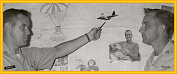
VR-8 History VR-8 History
Circa 1965
A BIT OF HISTORY:  "...VR-8 Maintains The Mighty Hercules That Fly The Pacific - Page 20 to 21 - Naval Aviation News - March 1965..." WebSite: http://www.history.navy.mil/nan/backissues/1960s/1965/mar65.pdf [31AUG2004] "...VR-8 Maintains The Mighty Hercules That Fly The Pacific - Page 20 to 21 - Naval Aviation News - March 1965..." WebSite: http://www.history.navy.mil/nan/backissues/1960s/1965/mar65.pdf [31AUG2004]
Circa 1959
A BIT OF HISTORY:  "...Pacific Constellations - Page 28 to 29 - Naval Aviation News - May 1959..." WebSite: http://www.history.navy.mil/nan/backissues/1950s/1959/may59.pdf [15AUG2004] "...Pacific Constellations - Page 28 to 29 - Naval Aviation News - May 1959..." WebSite: http://www.history.navy.mil/nan/backissues/1950s/1959/may59.pdf [15AUG2004]
Circa 1958
A BIT OF HISTORY:  "...Departure Record Is Set - Page 15 - Naval Aviation News - January 1958..." WebSite: http://www.history.navy.mil/nan/backissues/1950s/1958/jan58.pdf [12AUG2004] "...Departure Record Is Set - Page 15 - Naval Aviation News - January 1958..." WebSite: http://www.history.navy.mil/nan/backissues/1950s/1958/jan58.pdf [12AUG2004]

Circa 1957-1958
A BIT OF HISTORY: "...Personal collection of CPO Leon Prager..." Contributed by David Prager flyingsurfer1@gmail.com [20FEB2024]
TOP ROW - LEFT TO RIGHT: VR-8 Circa 26JUL1957, Dad Circa 1958, Dad Circa 1958, Shipmate, Shipmate, Shipmate and Shipmate
CENTER ROW - LEFT TO RIGHT: Shipmate, 19JUL1957, Squadron Aircraft, Helping Daddy Select His New Togs, Retiring Officers Circa 27FEB1958, Squadron Inspection Circa Circa 27FEB1958, Squadron Inspection Circa Circa 27FEB1958 and Dad Circa 1958
BOTTOM ROW - LEFT TO RIGHT: Shipmates Circa 26JUL1958
A BIT OF HISTORY:  "...School For R7V 'Know How' - Page 28 - Naval Aviation News - May 1957..." WebSite: http://www.history.navy.mil/nan/backissues/1950s/1957/may57.pdf [10AUG2004] "...School For R7V 'Know How' - Page 28 - Naval Aviation News - May 1957..." WebSite: http://www.history.navy.mil/nan/backissues/1950s/1957/may57.pdf [10AUG2004]

Circa 1956
A BIT OF HISTORY:  "...Money Donated To Home - Page 25 - Naval Aviation News - March 1956..." WebSite: http://www.history.navy.mil/nan/backissues/1950s/1956/mar56.pdf [08AUG2004] "...Money Donated To Home - Page 25 - Naval Aviation News - March 1956..." WebSite: http://www.history.navy.mil/nan/backissues/1950s/1956/mar56.pdf [08AUG2004]

Circa 1954
A BIT OF HISTORY:  "...VR-8 Get The 'New Look' - Page 17 - Naval Aviation News - March 1954..." WebSite: http://www.history.navy.mil/nan/backissues/1950s/1954/mar54.pdf [02AUG2004] "...VR-8 Get The 'New Look' - Page 17 - Naval Aviation News - March 1954..." WebSite: http://www.history.navy.mil/nan/backissues/1950s/1954/mar54.pdf [02AUG2004]

Circa 1953
A BIT OF HISTORY:  "...VR-8 The Navy's White Hat Squadron - Page 20 to 21 - Naval Aviation News - December 1953..." WebSite: http://www.history.navy.mil/nan/backissues/1950s/1953/dec53.pdf [01AUG2004] "...VR-8 The Navy's White Hat Squadron - Page 20 to 21 - Naval Aviation News - December 1953..." WebSite: http://www.history.navy.mil/nan/backissues/1950s/1953/dec53.pdf [01AUG2004]
A BIT OF HISTORY:  "...Pilots Learn To Fly R7V-1 - Page 16 - Naval Aviation News - April 1953..." WebSite: http://www.history.navy.mil/nan/backissues/1950s/1953/apr53.pdf [29JUL2004] "...Pilots Learn To Fly R7V-1 - Page 16 - Naval Aviation News - April 1953..." WebSite: http://www.history.navy.mil/nan/backissues/1950s/1953/apr53.pdf [29JUL2004]

A BIT OF HISTORY:  "...Pilot Passes 10,000 Hours - Page 32 - Naval Aviation News - February 1953..." WebSite: http://www.history.navy.mil/nan/backissues/1950s/1953/feb53.pdf [29JUL2004] "...Pilot Passes 10,000 Hours - Page 32 - Naval Aviation News - February 1953..." WebSite: http://www.history.navy.mil/nan/backissues/1950s/1953/feb53.pdf [29JUL2004]

Circa 1952
A BIT OF HISTORY:  "...Puttputt Sports Fancy Gadget - Page 22 - Naval Aviation News - August 1952..." WebSite: http://www.history.navy.mil/nan/backissues/1950s/1952/aug52.pdf [26JUL2004] "...Puttputt Sports Fancy Gadget - Page 22 - Naval Aviation News - August 1952..." WebSite: http://www.history.navy.mil/nan/backissues/1950s/1952/aug52.pdf [26JUL2004]

A BIT OF HISTORY:  "...Becoming A Habit - Page 29 - Naval Aviation News - February 1952..." WebSite: http://www.history.navy.mil/nan/backissues/1950s/1952/feb52.pdf [25JUL2004] "...Becoming A Habit - Page 29 - Naval Aviation News - February 1952..." WebSite: http://www.history.navy.mil/nan/backissues/1950s/1952/feb52.pdf [25JUL2004]

Circa 1951
A BIT OF HISTORY:  "...Airlift Medal Is Issued - Page 34 - Naval Aviation News - September 1951..." WebSite: http://www.history.navy.mil/nan/backissues/1950s/1951/sep51.pdf [25JUL2004] "...Airlift Medal Is Issued - Page 34 - Naval Aviation News - September 1951..." WebSite: http://www.history.navy.mil/nan/backissues/1950s/1951/sep51.pdf [25JUL2004]

A BIT OF HISTORY:  "...VR-8 Wins Safety Plaque - Naval Aviation News - May 1951..." WebSite: http://www.history.navy.mil/nan/backissues/1950s/1951/jun51.pdf [24JUL2004] "...VR-8 Wins Safety Plaque - Naval Aviation News - May 1951..." WebSite: http://www.history.navy.mil/nan/backissues/1950s/1951/jun51.pdf [24JUL2004]

A BIT OF HISTORY:  "...Light Spoils VR-8's Record - Page 20 - Naval Aviation News - April 1951..." WebSite: http://www.history.navy.mil/nan/backissues/1950s/1951/apr51.pdf [23JUL2004] "...Light Spoils VR-8's Record - Page 20 - Naval Aviation News - April 1951..." WebSite: http://www.history.navy.mil/nan/backissues/1950s/1951/apr51.pdf [23JUL2004]

A BIT OF HISTORY: "...Reel Makes Watering Easy and Key Opens Baggage Section - Page 36 - Naval Aviation News - April 1951..." WebSite: http://www.history.navy.mil/nan/backissues/1950s/1951/apr51.pdf [23JUL2004]
Circa 1948-1949
A BIT OF HISTORY:  VR-8 Mug "...Air Transport Squadron Eight - 1948 Operation Vittles 1949 - Harry L. Pearce - The Greatest Bridge of the World..." Contributed by JF Urruty jean-francois.urruty@umontreal.ca [17FEB2024] VR-8 Mug "...Air Transport Squadron Eight - 1948 Operation Vittles 1949 - Harry L. Pearce - The Greatest Bridge of the World..." Contributed by JF Urruty jean-francois.urruty@umontreal.ca [17FEB2024]
Circa 1949
A BIT OF HISTORY:  "...Navy Wins Airlift Honors - Page 15 - Naval Aviation News - November 1949..." WebSite: http://www.history.navy.mil/nan/backissues/1940s/1949/nov49.pdf [13JUL2004] "...Navy Wins Airlift Honors - Page 15 - Naval Aviation News - November 1949..." WebSite: http://www.history.navy.mil/nan/backissues/1940s/1949/nov49.pdf [13JUL2004]

A BIT OF HISTORY:  "...Wand Helps To Fix Loran - Page 39 - Naval Aviation News - March 1949..." WebSite: http://www.history.navy.mil/nan/backissues/1940s/1949/mar49.pdf [15JUL2004] "...Wand Helps To Fix Loran - Page 39 - Naval Aviation News - March 1949..." WebSite: http://www.history.navy.mil/nan/backissues/1940s/1949/mar49.pdf [15JUL2004]

A BIT OF HISTORY: "...01 JULY 1949 to 31 DECEMBER 1949 - Historical Report of Air Transport Service Command Air Transport Squadron EIGHT...Naval Historical Center ADOBE Download File: http://www.history.navy.mil/download/vr8-1.pdf [26MAY2003]

 01 JULY 1949 to 31 DECEMBER 1949 - Historical Report of Air Transport Service Command Air Transport Squadron EIGHT 1087KB 01 JULY 1949 to 31 DECEMBER 1949 - Historical Report of Air Transport Service Command Air Transport Squadron EIGHT 1087KB
Circa 1948
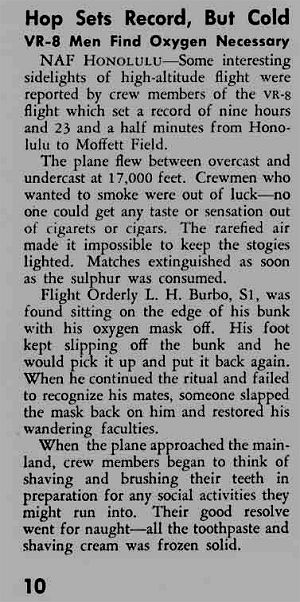
A BIT OF HISTORY:  "...Hop Sets Record, But Cold - Page 10 - Naval Aviation News - September 1948..." WebSite: http://www.history.navy.mil/nan/backissues/1940s/1948/sep48.pdf [08JUL2004] "...Hop Sets Record, But Cold - Page 10 - Naval Aviation News - September 1948..." WebSite: http://www.history.navy.mil/nan/backissues/1940s/1948/sep48.pdf [08JUL2004]
A BIT OF HISTORY:  "...Lightning Hits NATS Plane - Page 12 - Naval Aviation News - May 1948..." WebSite: http://www.history.navy.mil/nan/backissues/1940s/1948/may48.pdf [11JUL2004] "...Lightning Hits NATS Plane - Page 12 - Naval Aviation News - May 1948..." WebSite: http://www.history.navy.mil/nan/backissues/1940s/1948/may48.pdf [11JUL2004]

Circa 1946
A BIT OF HISTORY: "...US NAVY PILOT ID PB2Y AIRPLANE PHOTO TRAINING GUIDE - 1946 - All these items were owned and used by the same individual; he also was a WWII pilot. This lot contains United States Navy and Marine Corps ID card issued for Air Transport Eight VR-8, at NAS Patuxent River, Maryland dated 1946. Wallet size photo of what I believe is a "PB2Y". Orders, dated February, 1949 from 11th Naval District, San Diego. Air Transport Squadron Two (VR-2), Pilot Training Syllabus, dated April, 1945. This booklet is primarily training instructions for PB2Y. Also included is a business card when this pilot left service, and worked for United Airlines..." Ebay: http://cgi.ebay.com/ US-NAVY-PILOT-ID-PB2Y-AIRPLANE-PHOTO-TRAINING-GUIDE_W0QQitemZ6574781096QQcategoryZ13981QQssPageNameZWDVWQQrdZ1QQcmdZViewItem [31OCT2005]
Circa 1945
A BIT OF HISTORY:  "...Pictorial NAS Patuxent River, Maryland (Complied by the Office of Public Information) 1 November 1945 - Concrete arched hangars like the one to the left were used by Flight Test seaplane, Electronics Test, Operations, Service Test and VR-1. Center picture is a Seaplane hangar used by VR-8 had a structural steel arch. Note small control tower. Right picture is VR-8 Change-of-Command January 1945 when Commander Harry Canady relieved Commander J. C. Toth as squadron Commanding Officer..." [08JAN2005] "...Pictorial NAS Patuxent River, Maryland (Complied by the Office of Public Information) 1 November 1945 - Concrete arched hangars like the one to the left were used by Flight Test seaplane, Electronics Test, Operations, Service Test and VR-1. Center picture is a Seaplane hangar used by VR-8 had a structural steel arch. Note small control tower. Right picture is VR-8 Change-of-Command January 1945 when Commander Harry Canady relieved Commander J. C. Toth as squadron Commanding Officer..." [08JAN2005]
A BIT OF HISTORY: "...Success in battle depends heavily on adequate logistic support which many times provides the thin thread on which hangs the victory. Throughout its history, NAS Moffett Field, California has been home for one or more of these all-important air logistics units. Dating back to 1945 with the arrival of Transport Squadron Four (VR-4) and Naval Air Transport Service (NATS) headquarters, such squadrons as Transport Squadron Forty-four (VR-44), Transport Squadron Five (VR-5) and Transport Squadron Three (VR-3) have played an important role as one of NAS Moffett Field, California's tenant units. R4Ds (DC-3s), R5D (DC-5s) and R6D (DC-6s) were familiar sights in Bay Area skies. With the decommissioning of Fleet Logistic Air Wings in the summer of 1957, two Military Air Transport Squadrons, VR-7 and VR-8, began the move from their Hawaiian base to NAS Moffett Field, California. Flying the sleek R7V Super Constellation, these squadrons operate from here to the far reaches of the Pacific to provide a supply line of men and equipment to the Pacific Fleet..." http://www.moffettfieldmuseum.org/history/postwar/fleet-units.html [17JAN2004]
Circa 1943
A BIT OF HISTORY: "...VR-8 History..." http://navymats.com/VR-8.html [01JUN2002]
Naval Air Transport Squadron Eight (VR-8) was originally established at NAS Patuxent River, Maryland in October 1943. In November 1944 it began cargo and mail service to San Juan PR and Bermuda WI. It maintained a daily schedule with the Martin PBM Mariner aircraft. Few records exits for this time period and the squadron was disestablished in June 1946.
After the establishment of VR-11 at NAS Oakland, California in September 1943 it was moved to NAF Honolulu shortly thereafter and although the chronology is rather cloudy, sometime during the 1943-1945 period a detachment in the Pacific was designated VR-8 to support the Naval Air Transport activity on several islands including Guam. In November of 1946, these detachments and VR-11 were combined and the VR-8 designation affixed. The assumed the maintenance and suppoirt of Naval Air Transport units transiting the Pacific area, including the Martin Mars JRM flying from Keehi Lagoon in Hawaii.
With the advent of the Douglas R5D Skymaster into the Naval Air Transport Service, fewer fueling stops were required to transit the Pacific and VR-8 moved to Hickam AFB with a detachment still supporting the JRM at Keehi Lagoon until it was withdrawn from service. In January 1948 the squadron was assigned to the Military Air Transport Service along with VR-3 and VR-6. This unified command consisted of all the USAF Air Transport Command squadron and the three Navy units. This was followed in June 1948 by a move to Germany to supplement the Air Force in Operation Vittles supplying vital needs to the citizens of Berlin during the Russian Blockade. It was again joined by VR-6 operating into Berlin, with VR-3 operating between the U.S. and the allied controlled area of Germany.
Following the lifting of the Blockade the squadron returned to it's Pacific home at Hickam AFB and resumed its scheduled route between California and the far reaches of the Pacific. In 1957 during the reorganization of MATS, VR-8 moved to NAS Moffett Field, California along with VR-7 under command of the newly established Naval Air Transport Wing Pacific Division MATS.
At this time VR-8 was assigned custody of all aircraft from both squadrons and sole responsiblity for their maintenance. Although having a cadre of flight personnel it bacame the "Maintenance Squadron" of the Wing. VR-7 operating as the "Operational Squadron". In early 1963 the squadron began the enormous task of retireing the Super Constellation and accepting the new Hercules aircraft. This took place simultaneously until all R7V-1 aircraft had been displaced.
In January 1967 this proud group of dedicated men sadly dis-established a truely memorable portion of Naval Aviation history. During it"s two life times its aircraft and men had served and flown over two major oceans, with various types of aircraft - flying and maintaining enviable records wherever it was called upon to serve. A well deserved spot in Naval Aviation history should be opened for the squadron whose motto was "We Carry The Load".
Circa Unknown
Can you identify the Month and or Year?
A BIT OF HISTORY:  VR-8 Squadaron "...Personnel, probably of Transport Squadron Eight (VR-8), pictured in front of a squadron PB2Y-5R aircraft at NAS Patuxent River, MD..." WebSite: National Museum of Naval Aviation http://collections.naval.aviation.museum/emuwebdoncoms/pages/doncoms/ResultsList.php [27MAY2007] VR-8 Squadaron "...Personnel, probably of Transport Squadron Eight (VR-8), pictured in front of a squadron PB2Y-5R aircraft at NAS Patuxent River, MD..." WebSite: National Museum of Naval Aviation http://collections.naval.aviation.museum/emuwebdoncoms/pages/doncoms/ResultsList.php [27MAY2007]
A BIT OF HISTORY: "...Navy Air in the Berlin Airlift (VR-8) By Capt. Daniel W. Christensen, USNR...Naval Historical Center ADOBE Download File: http://www.history.navy.mil/download/airlif-b.pdf [26MAY2003]
Navy Air in the Berlin Airlift (VR-8) 348KB

"VR-8 Summary Page"
|