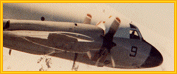
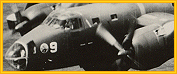
The Navy Hymn Sailor Aviators Version Whose arm hath bound the restless wave, Who bid'st the mighty Ocean deep Its' own appointed limits keep; O hear us when we cry to thee, for those in peril on the sea. Lord, guard and guide the men who fly Through the great spaces in the sky. Be with them always in the air, In dark'ning storms or sunlight fair. O, Hear us when we lift our prayer, For those in peril in the air. But when at length our course is run, Our work for home and country done, Of all the souls that flew and sailed, Let not one life in thee be failed, But hear from heaven our sailors cry, And grant eternal life on high. May all our departed shipmates rest in peace.  Eternal Father by the U.S. Navy Band's Sea Chanters (668 kbytes - WAV file) Eternal Father by the U.S. Navy Band's Sea Chanters (668 kbytes - WAV file) April 12, 1973 Lost Birds Magazine Discover Aviation Archaeology  JAN/MAR 1998 http://www.lostbirds.com Lost Birds Member Magazine Vol. 1 No.1 On Final Approach "Go around, go around...WEAVE!" NAS Moffett Field, California, located 30 miles south of San Francisco, California, was a busy facility in 1973. The air station was the headquarters for all US Navy patrol activity in the Pacific, and in this role it was home to many patrol squadrons flying the Lockheed P-3 Orion. NAS Moffett Field, California was also home to NASA's Ames Research Center, which at the time operated a wide variety of research and experimental aircraft. On April 12, 1973, a Navy P-3C and a Convair 990 operated by NASA collided while on final approach to Moffett field, killing 16 of the 17 people aboard the two aircraft.  Aerial view depicts both aircraft. The Convair 990 tail-section shown here on lower right. Courtesy of NASA via Ian Abbott. According to eyewitnesses, the P-3 pulled up sharply in the moment before the collision, perhaps in an evasive action. Galileo struck the upper aft fuselage of the P-3 and the two aircraft crashed entangled on the l2th tee of the Sunnyvale Municipal Golf Course. A large fire immediately engulfed the two wrecked aircraft. Although there were people playing golf nearby, miraculously no one on the ground was hurt. The crash scene quickly became chaotic. The two aircraft crashed just 200 yards from the Bayshore Freeway, and drivers left their cars to scale the fence and rush to the burning wreckage. Golfers, and people from nearby office buildings who had seen the crash also swarmed around the site. The large number of onlookers made access difficult for the crews responding from NAS Moffett Field, California and Sunnyvale. At the time of the crash a group of firemen were watching a demonstration of a jaws of life rescue device at the Mountain View training center. When they saw the crash they loaded the rescue equipment and went to the scene. All of the sixteen men who were killed died in the crash or in the fire that followed it. The one survivor was Petty Officer Third Class Bruce N. Mallibert, who was an observer on the P-3. One of the golfers at the crash scene found Mallibert seriously injured and lying unconscious outside of the wreckage, and mistakenly thought that he was dead. He covered Malliberts body with a parachute, but soon after that a fireman checked Mallibert and discovered that he was still alive. Mallibert was lucky to have survived the crash, but he would escape death a second time minutes later. While the parachute covered him a fire truck drove over him, unaware that he was underneath. Miraculously, the trucks wheels missed Mallibert on both sides. He was taken to a nearby hospital where he remained in critical condition for many days. This crash renewed calls for the Navy to leave NAS Moffett Field, California, and several local members of Congress called for a halt to flying from Moffett in the days following the crash. While there had been a large number of crashes around the air station when it was a home to fighters and attack aircraft in the 1950s, the safety record of the P-3 operations was excellent. This collision was the first and only crash of a P-3 near the airfield between the early 1960s and 1994 when the Navy decommissioned NAS Moffett Field, California. With the loss of Galileo, NASA lost a unique research asset in addition to losing several of the scientists who had helped to develop the flying laboratory and its experiments. Many of the programs that were to use Galileo were either delayed for years or were cancelled completely following the crash. This accident apparently occurred because of a simple mistake in air traffic control procedures. Neither of the aircraft suffered mechanical problems, the weather was excellent, and the crew aboard each aircraft was well trained and experienced. Sixteen men and two valuable aircraft were lost, but hopefully future accidents were averted by an increased awareness of the factors that caused this tragedy.  Here rescue workers attempt to put out the hotspots and later retrieve the crash victims. Courtesy of NASA via Ian Abbott According to eyewitnesses, the P-3 pulled up sharply in the moment before the collision, perhaps in an evasive action. Galileo struck the upper aft fuselage of the P-3 and the two aircraft crashed entangled on the l2th tee of the Sunnyvale Municipal Golf Course. A large fire immediately engulfed the two wrecked aircraft. Although there were people playing golf nearby, miraculously no one on the ground was hurt. The crash scene quickly became chaotic. The two, aircraft crashed just 200 yards from the Bayshore Freeway, and drivers left their cars to scale the fence and rush to the burning wreckage. Golfers, and people from nearby office buildings who had seen the crash also swarmed around the site. The large number of onlookers made access difficult for the fire crews responding from NAS Moffett Field, California and Sunnyvale. At the time of the crash a group of firemen were watching a demonstration of a jaws of life rescue device at the Mountain View fIre training center. When they saw the crash they loaded the rescue equipment and went to the scene.
 "...I just re-read the account of the VP-47 P-3 midair with the NASA Convair (SEE: VP-47 - In Memorial for lost friends April 12, 1973) and something jumped out at me. The account mentioned that the NASA pilot didn't question the change to runway 32L. In his defense (not that it's acceptable), our common practice was to allow NASA 711 to land on 32L whenever we could because, after landing, it was a quick turnoff at the intersection near the NASA ramp and a straight shot to the ramp. But what keeps sticking in my mind is a memory that one of the pilots simply asked "Are we cleared to land?", without using a call sign, and the controller, assuming it was the P-3 on final for the left side and said (again without using a call sign) "Cleared to land 32 left." Was it the NASA pilot that asked that? I guess we'll never know, but that's the way I remember it. Since this incident continues to haunt me, I've searched for a transcript of the incident, but can't find it. I just pray that the aviation community in general, and the ATC community in particular, learned a hard lesson from this tragedy..." Contributed by ACCS Paul Klawitter paul@jklawitter.com [16DEC2014]
"...I was working in the control tower that terrible day a VP-47 P-3 collided with a NASA Convair 990 (SEE: In Memorial for (VP-47) lost friends April 12, 1973). I still have some rough times when the incident flashes back in my memory because I always second guess myself about "if I could've only recognized what was happening", but I had a trainee working ground control and that was my focus that busy day. I read the post by LT Mischkot about relaying a message to the controller involved that there were no hard feelings. The controller working that day was AC1 Ray Sprinkle and I'm sure that if he had received that message, it would've meant a lot to him. I knew Ray pretty well. Worked with hime every day. He did go through a period of re-training but was never able to re-qualify. I don't know if it was a lack of confidence in himself or a lack of trust from other controllers who had to sign on with him and give their OK that he was ready for requalification. He ended up changing his rate to one of the computer-related jobs and went away. After I retired in 1992, I saw in the Navy Times that Ray had passed away sometime in 1994. God bless him. So, on this Thanksgiving Day, 2014, I am thankful for my blessings, and my heart goes out to all of the families and friends of those who were lost that day. I wonder how the lone survivor is making out. God bless him, too..." Contributed by ACCS Paul Klawitter, Retired paul@jklawitter.com [28NOV2014] "...I just re-read the account of the VP-47 P-3 midair with the NASA Convair (SEE: VP-47 - In Memorial for lost friends April 12, 1973) and something jumped out at me. The account mentioned that the NASA pilot didn't question the change to runway 32L. In his defense (not that it's acceptable), our common practice was to allow NASA 711 to land on 32L whenever we could because, after landing, it was a quick turnoff at the intersection near the NASA ramp and a straight shot to the ramp. But what keeps sticking in my mind is a memory that one of the pilots simply asked "Are we cleared to land?", without using a call sign, and the controller, assuming it was the P-3 on final for the left side and said (again without using a call sign) "Cleared to land 32 left." Was it the NASA pilot that asked that? I guess we'll never know, but that's the way I remember it. Since this incident continues to haunt me, I've searched for a transcript of the incident, but can't find it. I just pray that the aviation community in general, and the ATC community in particular, learned a hard lesson from this tragedy..." Contributed by ACCS Paul Klawitter paul@jklawitter.com [16DEC2014]
"...I was working in the control tower that terrible day a VP-47 P-3 collided with a NASA Convair 990 (SEE: In Memorial for (VP-47) lost friends April 12, 1973). I still have some rough times when the incident flashes back in my memory because I always second guess myself about "if I could've only recognized what was happening", but I had a trainee working ground control and that was my focus that busy day. I read the post by LT Mischkot about relaying a message to the controller involved that there were no hard feelings. The controller working that day was AC1 Ray Sprinkle and I'm sure that if he had received that message, it would've meant a lot to him. I knew Ray pretty well. Worked with hime every day. He did go through a period of re-training but was never able to re-qualify. I don't know if it was a lack of confidence in himself or a lack of trust from other controllers who had to sign on with him and give their OK that he was ready for requalification. He ended up changing his rate to one of the computer-related jobs and went away. After I retired in 1992, I saw in the Navy Times that Ray had passed away sometime in 1994. God bless him. So, on this Thanksgiving Day, 2014, I am thankful for my blessings, and my heart goes out to all of the families and friends of those who were lost that day. I wonder how the lone survivor is making out. God bless him, too..." Contributed by ACCS Paul Klawitter, Retired paul@jklawitter.com [28NOV2014]
 Dad! "...My father, Bill Russey, was lost April 12, 1973 (SEE: In Memorial for (VP-47) lost friends April 12, 1973). I never got to meet him. I was born a few months too late. I have often wondered what he was like as a person and who I'd be if he had lived. I have two sons now, my oldest named Billy also. I wish I knew more of who he was, to tell them stories. But we have pictures and I'm sure he sees us from where he is. I am sorry for eveyone's loss and appreciate the sacrifices our military makes for our freedoms. Thank you Dad, I hope to meet you finally someday. God Bless..." Contributed by William Russey lrussey74@hotmail.com [03FEB2013]
"...I witnessed this crash (SEE: In Memorial for (VP-47) lost friends April 12, 1973) from the highway that went through the golf course. I was picking up some golf balls hit next to the highway when I saw the Convair change run ways from 36 r to 36 L at about 3 miles from the golf course. As a private pilot I "got" the significance of what I was seeing and got into my car and drove quickly west bound so I would not be under the flight path of these converging aircraft. I watched the Convair essentially land on the vertical tail of the P-3, pushing it down thus causing the nose to point almost straight up. The P-3 did a loop and crashed nose first on the golf course. The Convair's pilot gave his bird full power but his nose was too high and his aircraft appeared to slowly flew backwards, tail first back onto the golf course. While the Convair appeared to have little outward damage besides a collaped landing gear, the port wing tip was on fire and the fire moved quickly to the body of the aircraft. A few very brave golfers attemped to break the front window of the aircraft but the glass was to thick. The golfers were forced to get away from the aircraft due to the of the fire. An interesting footnote: The Convair made an earlier landing at NAS Moffett Field, California while I was putting and I remember looking up at the co pilot who was looking at me getting ready to putt and he extended his hands in acknowledgement of my short putt and smiled at me and visa versa. Little did either of us know at the time that within 3 hours he would meet his maker. So tragic and so unnecessary. You could see 80 miles this sunny day. One would think that between all of the crew members and the controller that someone would have noticed the conflicting runway assignment..." Contributed by bobcarter43@yahoo.com [25AUG2010]
"...I served with VP-47 from 1971 to 1974 at NAS Moffett Field, California. We were on deployment at the time the accident (SEE: In Memorial for VP-47 lost friends April 12, 1973) happened. I was at NAS Adak, Alaska when we got the word that RD5 had crashed with another aircraft. At first we were told that there were no survivors. I was happy to hear later that Bruce Mallibert had survived. I had the pleasure of knowing and flying with Bruce on several occasions during our deployments and when the squadron was home at NAS Moffett Field, California. I remember him as a good athelete because we played team basketball and flag football together. We lost part of our family that day on April 12, 1973. I will always remember that day and the crew that was lost...VEGA, RM3 David J. bigdvegad@yahoo.com..." [15APR2010]
"...My father was often on the Galileo (SEE: In Memorial for (VP-47) lost friends April 12, 1973) that mentioned along with the P-3 at NAS Moffett Field, California. I've been on the plane myself. All day long I answered the phone Dad's alive. Hello. Again and again and again. I remember his saying there was one Scientist/Engineer whose experiment was not quite right so he stayed on the ground to work on it. Even today, about 37 years later, I can remember what the golf course looked like with wreckage on it. Margie margie402@yahoo.com..." [31MAR2009]
"...My brother, Bill (Wm Frank) Russey, was the FE on the P-3 that crashed on April 12, 1973 (SEE: VP-47 - In Memorial for lost friends April 12, 1973). While I was in California for the Memorial, I went to the hospital to visit the Mallibert family and have oftened wondered about Bruce, who was the lone survivor ot the horrific crash. My father, a WW 2 vet. was the braviest and most impressive Dad when he said that he felt privileged that God gave him Bill for 31 years. I have oftened wondered of the condition and wherabouts of Bruce Mallibert. May God Bless all sailors who have given their lives so we could be a free nation. Nancy Russey Mock mastersgo@pobox.com..." [02MAR2009]
"...I was seven at the time of the VP-47 - In Memorial for lost friends April 12, 1973 at NAS Moffett Field, California. I remember seeing the smoke from my backyard in Mountain View. My neighbor Mr. Cross was a NASA scientist killed on that flight and I recall all of the cars showing up around 4PM to comfort his wife Eleanor. My mother and Eleanor Cross were closs friends. My best friend's father was on the golf course at the time and saw the whole thing. Strange that something should hit so close at such a young age, and I did some growing up that day. God Bless the victims, the families, and their friends even to this day. They will not be forgotten. Scott Evan Nelson snelson17@comcast.net..." [16OCT2008]
"...It has been 35 years since VP-47's Mishap (VP-47 - In Memorial for lost friends April 12, 1973). I still remember what a great bunch of guys were on RD5. I flew with LT Schwarting and crew around the Mariannas out of NAS Agana, Guam. That flight was a really great experience I will never forget. Martin Grupp mgnewlookauto@sbcglobal.net..." [13APR2008]
"...It was my last day in the navy. I was in VP-9, AE2. I had just come back early from the deployment to NAS Iwakuni, Japan to end my enlistment. I walked out of the credit union and the planes crashed into the golf course across the freeway (SEE: In Memorial for lost friends April 12, 1973). I could see a golfer with his golf club hitting the thick windows of the P-3 until the heat forced him back. I think that he could see someone inside trying to get out and in the extreme panic and disorientation not pulling the handle on the overhead escape hatch in the cockpit. I have never forgotten this tragic event...Dan DUKES dansoffice@comcast.net..." [28FEB2008]
"...Steve (LT Stephen A. Schwarting) was my roommate and friend during Plebe Summer at the Naval Academy. I have just returned from our 40th reunion and found this when I did a search for Steve. During our memorial service this morning, our chaplain and classmate encouraged us to speak our our classmates' names during a normally silent prayer of remembrance. I said Steve's name and I heard his name from many other classmates in the group. Be assured that Steve has not been forgotten. He was a great guy and we miss him sorely...Peter Smullen pete_smullen@hotmail.com..." [22OCT2007]
"...I was a Corspman on duty the day Petty Officer Third Class Bruce N. Mallibert (VP-47 Observer) arrived at the US Naval hospital, in Oakland (SEE: In Memorial for lost friends April 12, 1973). His burns and injuries were so severe, we had no doubt he would only survive a day at the most, if that long. I was the Sr. Corpsman on the ward he ended up at, and I've never seen any patient with so many things busted up or burnt. He was missing 1 inch of his spine....yes, his spine. The top of his skull had been removed to prevent brain swelling problems and his exposed brain was covered with a saline gauze. Both legs had multiple fractures and were in traction. He had 3rd degree burns over 20% of his body. Both arms were burnt and broken, back and neck broken, some internal injuries, and in a coma for more than a month. The initial prognosis for Bruce was not good. "Hour by hour" for the first few days. I would escort his family and fiance to his room each week and got to know them pretty well. They came up from Sunnyvale. (We honestly thought he would never recover and would die while in the coma). Then came the day I was told he was coming out of his coma, goin in and out of consciousness. His family was in the room. This is a little eerie, but I went into his room and began talking to his family, and Bruce had his eyes closed and appeared to be sleeping. Out of no where, the first thing he said was "Larry is that you?" I'll never forget that or forget Bruce. A few years later, when I was in the reserves, I heard he was transferred to a VA hospital in So. Ca. and was actually re-learning how to walk. I couldn't believe it, especially with his spinal injury. God Bless the men who lost their lives. Bruce, if you ever read this, please contact me...Larry Taylor..." [03SEP2006] Dad! "...My father, Bill Russey, was lost April 12, 1973 (SEE: In Memorial for (VP-47) lost friends April 12, 1973). I never got to meet him. I was born a few months too late. I have often wondered what he was like as a person and who I'd be if he had lived. I have two sons now, my oldest named Billy also. I wish I knew more of who he was, to tell them stories. But we have pictures and I'm sure he sees us from where he is. I am sorry for eveyone's loss and appreciate the sacrifices our military makes for our freedoms. Thank you Dad, I hope to meet you finally someday. God Bless..." Contributed by William Russey lrussey74@hotmail.com [03FEB2013]
"...I witnessed this crash (SEE: In Memorial for (VP-47) lost friends April 12, 1973) from the highway that went through the golf course. I was picking up some golf balls hit next to the highway when I saw the Convair change run ways from 36 r to 36 L at about 3 miles from the golf course. As a private pilot I "got" the significance of what I was seeing and got into my car and drove quickly west bound so I would not be under the flight path of these converging aircraft. I watched the Convair essentially land on the vertical tail of the P-3, pushing it down thus causing the nose to point almost straight up. The P-3 did a loop and crashed nose first on the golf course. The Convair's pilot gave his bird full power but his nose was too high and his aircraft appeared to slowly flew backwards, tail first back onto the golf course. While the Convair appeared to have little outward damage besides a collaped landing gear, the port wing tip was on fire and the fire moved quickly to the body of the aircraft. A few very brave golfers attemped to break the front window of the aircraft but the glass was to thick. The golfers were forced to get away from the aircraft due to the of the fire. An interesting footnote: The Convair made an earlier landing at NAS Moffett Field, California while I was putting and I remember looking up at the co pilot who was looking at me getting ready to putt and he extended his hands in acknowledgement of my short putt and smiled at me and visa versa. Little did either of us know at the time that within 3 hours he would meet his maker. So tragic and so unnecessary. You could see 80 miles this sunny day. One would think that between all of the crew members and the controller that someone would have noticed the conflicting runway assignment..." Contributed by bobcarter43@yahoo.com [25AUG2010]
"...I served with VP-47 from 1971 to 1974 at NAS Moffett Field, California. We were on deployment at the time the accident (SEE: In Memorial for VP-47 lost friends April 12, 1973) happened. I was at NAS Adak, Alaska when we got the word that RD5 had crashed with another aircraft. At first we were told that there were no survivors. I was happy to hear later that Bruce Mallibert had survived. I had the pleasure of knowing and flying with Bruce on several occasions during our deployments and when the squadron was home at NAS Moffett Field, California. I remember him as a good athelete because we played team basketball and flag football together. We lost part of our family that day on April 12, 1973. I will always remember that day and the crew that was lost...VEGA, RM3 David J. bigdvegad@yahoo.com..." [15APR2010]
"...My father was often on the Galileo (SEE: In Memorial for (VP-47) lost friends April 12, 1973) that mentioned along with the P-3 at NAS Moffett Field, California. I've been on the plane myself. All day long I answered the phone Dad's alive. Hello. Again and again and again. I remember his saying there was one Scientist/Engineer whose experiment was not quite right so he stayed on the ground to work on it. Even today, about 37 years later, I can remember what the golf course looked like with wreckage on it. Margie margie402@yahoo.com..." [31MAR2009]
"...My brother, Bill (Wm Frank) Russey, was the FE on the P-3 that crashed on April 12, 1973 (SEE: VP-47 - In Memorial for lost friends April 12, 1973). While I was in California for the Memorial, I went to the hospital to visit the Mallibert family and have oftened wondered about Bruce, who was the lone survivor ot the horrific crash. My father, a WW 2 vet. was the braviest and most impressive Dad when he said that he felt privileged that God gave him Bill for 31 years. I have oftened wondered of the condition and wherabouts of Bruce Mallibert. May God Bless all sailors who have given their lives so we could be a free nation. Nancy Russey Mock mastersgo@pobox.com..." [02MAR2009]
"...I was seven at the time of the VP-47 - In Memorial for lost friends April 12, 1973 at NAS Moffett Field, California. I remember seeing the smoke from my backyard in Mountain View. My neighbor Mr. Cross was a NASA scientist killed on that flight and I recall all of the cars showing up around 4PM to comfort his wife Eleanor. My mother and Eleanor Cross were closs friends. My best friend's father was on the golf course at the time and saw the whole thing. Strange that something should hit so close at such a young age, and I did some growing up that day. God Bless the victims, the families, and their friends even to this day. They will not be forgotten. Scott Evan Nelson snelson17@comcast.net..." [16OCT2008]
"...It has been 35 years since VP-47's Mishap (VP-47 - In Memorial for lost friends April 12, 1973). I still remember what a great bunch of guys were on RD5. I flew with LT Schwarting and crew around the Mariannas out of NAS Agana, Guam. That flight was a really great experience I will never forget. Martin Grupp mgnewlookauto@sbcglobal.net..." [13APR2008]
"...It was my last day in the navy. I was in VP-9, AE2. I had just come back early from the deployment to NAS Iwakuni, Japan to end my enlistment. I walked out of the credit union and the planes crashed into the golf course across the freeway (SEE: In Memorial for lost friends April 12, 1973). I could see a golfer with his golf club hitting the thick windows of the P-3 until the heat forced him back. I think that he could see someone inside trying to get out and in the extreme panic and disorientation not pulling the handle on the overhead escape hatch in the cockpit. I have never forgotten this tragic event...Dan DUKES dansoffice@comcast.net..." [28FEB2008]
"...Steve (LT Stephen A. Schwarting) was my roommate and friend during Plebe Summer at the Naval Academy. I have just returned from our 40th reunion and found this when I did a search for Steve. During our memorial service this morning, our chaplain and classmate encouraged us to speak our our classmates' names during a normally silent prayer of remembrance. I said Steve's name and I heard his name from many other classmates in the group. Be assured that Steve has not been forgotten. He was a great guy and we miss him sorely...Peter Smullen pete_smullen@hotmail.com..." [22OCT2007]
"...I was a Corspman on duty the day Petty Officer Third Class Bruce N. Mallibert (VP-47 Observer) arrived at the US Naval hospital, in Oakland (SEE: In Memorial for lost friends April 12, 1973). His burns and injuries were so severe, we had no doubt he would only survive a day at the most, if that long. I was the Sr. Corpsman on the ward he ended up at, and I've never seen any patient with so many things busted up or burnt. He was missing 1 inch of his spine....yes, his spine. The top of his skull had been removed to prevent brain swelling problems and his exposed brain was covered with a saline gauze. Both legs had multiple fractures and were in traction. He had 3rd degree burns over 20% of his body. Both arms were burnt and broken, back and neck broken, some internal injuries, and in a coma for more than a month. The initial prognosis for Bruce was not good. "Hour by hour" for the first few days. I would escort his family and fiance to his room each week and got to know them pretty well. They came up from Sunnyvale. (We honestly thought he would never recover and would die while in the coma). Then came the day I was told he was coming out of his coma, goin in and out of consciousness. His family was in the room. This is a little eerie, but I went into his room and began talking to his family, and Bruce had his eyes closed and appeared to be sleeping. Out of no where, the first thing he said was "Larry is that you?" I'll never forget that or forget Bruce. A few years later, when I was in the reserves, I heard he was transferred to a VA hospital in So. Ca. and was actually re-learning how to walk. I couldn't believe it, especially with his spinal injury. God Bless the men who lost their lives. Bruce, if you ever read this, please contact me...Larry Taylor..." [03SEP2006]
UPDATE: Bruce and I connected back in 2006 - thank you everyone for your help. Larry Taylor..." [18FEB2016] "...My Father, Jim Remington, was one of the crew members on board the NASA Convair 990 (SEE: Memorial for lost friends April 12, 1973) who died that day. I've spent quite a bit of time over the past few years on the net trying to gather information and just try to make sense of what happened, I was about 2 and a half when it happened. I was very pleased to find this tribute to all of the men who lost their lives in that accident, and I wanted to say thank you...Jay Remington gordocoop@comcast.net..." [09APR2006]
"...I read about the incident that happened on the P-3C aircraft as I was in NAS Agana, Guam with Ken Holmes and crew four. As soon as we received the notice we flew back to NAS Moffett Field, California with CDR Rex Featherston to be with the people. I was in the funeral with other members of the squadron. If my recollection is correct there were two FE's on that terrible flight. One was Chief McDowell and the other was a friend of Mine named Bill Russey, an AE1. This was a sad day for all of the P-3 community..." Contributed by PERRY, AE2 Don donfperry@valornet.com [13MAY2004]
"...I was a member of VP-47 from 1971 to 1974 and I actually flew back to NAS Moffett Field, California from NAS Adak, Alaska the night before that crash on 12 April 1973 (SEE: In Memorial for lost friends April 12, 1973) on the same plane that crashed. When we landed on the tarmack we were greated by a great guy named Bruce Mallibert. Bruce was actually standing watch at the time. At the time, our squadron was split between NAS Moffett Field, California, NAS Adak, Alaska, and NAS Agana, Guam. My friend Mike Gleaves and I were pretty excited when we were told we could come home for a couple of weeks from NAS Adak, Alaska, as anyone would be, and I remember when we were landing that night the pilot played John Denver's "Country Road" song over the aircraft's speaker system. As we near the 33rd aniversary of this tragedy I will keep in my thoughts and prayers the families of those who died in this crash as well as you too Bruce. You were always an inspriation of strength following that crash and to hear that shortly afterwards you were giving of yourself to speak in schools further serves to demonstrate that strength. I will never forget you all. God Bless...CLARK, Larry frog020899@yahoo.com..." [06APR2006]
"...I served with VP-47 from April 1971 to January 1975. The only survivor of the NASA crash, Bruce Mallibert, was a personal friend (SEE: In Memorial for lost friends April 12, 1973). I knew and flew with all aboard. I was on watch at our NAS Agana, Guam detachment and on the phone with the D.O. at NAS Moffett Field, California when the crash occured. A sad day...HOLMES, Ken kholmes@direcway.com [04DEC2003]
"...I am the high school golfer mentioned in Lee Boyd's eyewitness account of the P-3 and Convair 990 crash over Sunnyvale Muni Golf Course in 1973 (SEE: In Memorial for lost friends April 12, 1973). I stumbled upon the article accidently during a Google search of my name, as I am a retired professional racing driver. If there are readers interested in asking questions of my recollections, I would be glad to respond...Ray Kong rkr96@aol.com [20NOV2003]
"...My father, LT Stephen A. Schwarting, was one of the VP-47 servicemen killed on April 12, 1973. I came across your memorial page this afternoon, and think it is a wonderful tribute. I happened to find it because I had been watching a P-3 Orion perform a series of touch-and-goes at our local airport. Thank you...Thomas Schwarting axledr@yahoo.com [17APR2003]
"...My name is Lee Boyd and I was an Aerial Photographer at NAS Moffett Field, California from 1951-54. After I got out of the Navy in 1954, I got my degree and I went into teaching.I was on the Sunnyvale Municipal Golf Course with my golf team on April 12, 1973 and I witnessed the crash. I was walking down the 2nd fairway with the other golf coach and I saw The P-3 and NASA jet in a stepped-up echelon over the runway. I said to my self what are those two planes doing in that position. The P-3 was on top and the NASA jet was on the bottom and they started to hit each other. The P-3 started to pull up and the NASA jet did too. I assume that they both realized that they were coming in on the runway. As the P-3 was trying to abort the NASA jet came up and punched a huge hole in the fuselage. I'll never forget the gapping hole the jet made in the top of the P-3's fuselage. They both fell to the ground at the 12th tee of the golf course. Our last foursome of student golfers were over on # 3 and we were concerned for their safety. The other coach and I ran down the #2 fairway and ran under the tunnel to #3 fairway to check on the players. Both planes caught on fire at impact and other golfers were trying to break the front window of the planes to give help. Ray Kong, a golfer from the Sunnyvale High School golf team, threw a parachute over the loan survivor. The Crash trucks had a very difficult time getting on the course because the course was fenced and the Crash Crew had did not have quick access to the gates. I saw the one Crash truck drive over the parachute with the loan survivor underneath the white chute and I said to myself and other people that "I guess the driver didn't know that Bruce was under the chute." I tried to get the golf teams to safety and I saw the ambulance load Bruce on a stretcher. He appeared to be a pretty big guy. I believe that Bruce was kicked out of the tail section of the P-3 Orion and landed between the #3 rd#12 fairways. The other golf coach and I got the players off the course and safely home. Bruce Mallibert, the loan survivor, came to Sunnyvale High School in 1978 were I taught and talked to students about being on drugs and I told him that I witnessed his accident. If you have any questions, please contact me..." Contributed by Lee Boyd Boydfour@aol.com [30NOV2002] "...Could you please change the date for VP-47 P-3 crash with Convair 990. It should be 12APR73 not 15MAR73..." Contributed by James Wilcox jfwilcox@pacbell.net [18APR2000]
"...My very last flight as PP2P at NAS Moffett Field, California occurred Thursday, April 12, 1973 while we were in the "touch and go" pattern on 36 left. I gently brought the aircraft to a landing and then made the required runway turn off.All of the sudden my left seater cried out several obscenities. Not thinking that was such a bad landing, I glanced to my right only to see a horrendous red-orange fireball and thick black smoke billowing from the approach end of the dual runways. Almost instantly tower called out "CRASH CRASH CRASH-All aircraft on the deck at Moffett clear the runways and position and hold! All aircraft in the Moffett pattern depart to a holding position or divert to alternate airfields!". A NASA 990 Convair had inadvertently been directed to land "36 left for visual" when in fact the controller meant to say "36 right for visual". NASA 990 rogered and then promptly landed on top of a VP-477 P-3-C on final for 36 left at about 400 feet AGL. Both aircraft wrapped themselves up and plummeted to the Sunnyvale golf course. There were five Navy fatalities and 11 fatalities aboard the NASA aircraft. Only one survivor. I had the distinct honor of meeting this gent while I was the OOD several months later. He wanted to let the controller (who had been retrained after a long hospital and psychiological stay) that there were no hard feelings. I told the gent that I would let the controllor know but it would be in the best interests of all concerned if he be left alone for now...." Contributed by Philip Mischkot, LT (USNR-RS) pjm3@texoma.net [07AUG99]  "VP-47 Mishap Summary Page" "NASA Mishap Summary Page"
| ||||||||||||